
The secondhand market isn't going to solve the clothing problem. (24/52)
Related: I'm doing a sustainable clothing challenge.

Many sources on sustainable clothing list "things you can do" to lower your fashion footprint, and virtually all of those lists begin with "purchase secondhand." This isn't a long-term solution, though almost no one wants to talk about that. Buying used clothing only works in certain circumstances and for a specific subset of buyers.
Generally, these articles or books advise you to purchase higher quality items at thrift stores and may even have a list of what to look for when evaluating garments. Yes, French seams and bound buttonholes are indeed characteristics of well-made items. And you won't find those details in a thrift store. You might find them on The Real Real, but you won't find them at Goodwill.
When people say to shop thrift stores for "higher quality" items, they ignore that mid-range clothing standards have dropped almost to the quality level of fast fashion. In the early 00s, thrift stores still had higher quality items (in straight sizes) that had been manufactured some years before, but the current glut of low-quality clothing means that this no longer holds true. Quality clothing is rare in thrift stores as people donate what they're currently buying, and right now, that's primarily fast fashion.
The lack-of-quality situation is bad enough in straight sizes, but plus sizes are even harder to thrift for, especially over a size 20. The higher the size, the more impossible it is to find in any quantity, let alone quality. It's also difficult to find petite or tall items in any size range, and petite or tall plus sizes are practically mythical.
Further, most thrift stores are already picked over twice: First by the staff who pull higher quality items for their charity's web store, and then by flippers who buy thrift store clothing to resell at a higher price on Poshmark or Depop. (This is mainly why I primarily buy my own "higher quality" secondhand clothes online: I haven't been able to find much of anything in local thrift stores in years.) Flipping also tends to price the poor out of the secondhand market, which is problematic.
My main issue with "buying used" is that it relies on the current broken system. A pool of people must purchase so much clothing that they can discard it at a pace that allows others to buy those discards before they're worn out. Used clothing doesn't magically appear with its manufacturing inputs somehow dissipated through virtue. These garments come from someone's closet. Used clothing is a stop-gap measure, not a long-term consumer solution, and only functions as a part of the sustainable fashion solution when other buyers over-consume.
Buying secondhand helps a few people, but most people need to purchase new clothing. So how can we help to make the fashion and textile industry less harmful?
I won't deny that the way we currently clothe ourselves is an environmental disaster. We don't live in a perfect or equitable world. I know systemic solutions are far more effective than individual action, but I also believe in starting where you are. An individual effort may be imperfect, but it can help to inspire others, and perhaps collectively, we can nudge the industry into change.
So I decided to take on a sustainable fashion challenge.
I love clothing, though I'm not fashion-oriented. I don't chase trends or keep up with haute couture, though I have my own personal style. (It's not flashy or particularly "Instagram-able," but it's mine!) I sew a lot of my clothing, but I also buy clothes like most people. I try to be intentional with my clothing choices, and though I'm not a minimalist, I don't have the closet full of options I used to have. I didn't want to do a capsule wardrobe challenge, a no-buy challenge, or a limited sewing challenge. I had been kicking around various ideas for over a year when I came across the 100 Day Dress Challenge from Wool&.
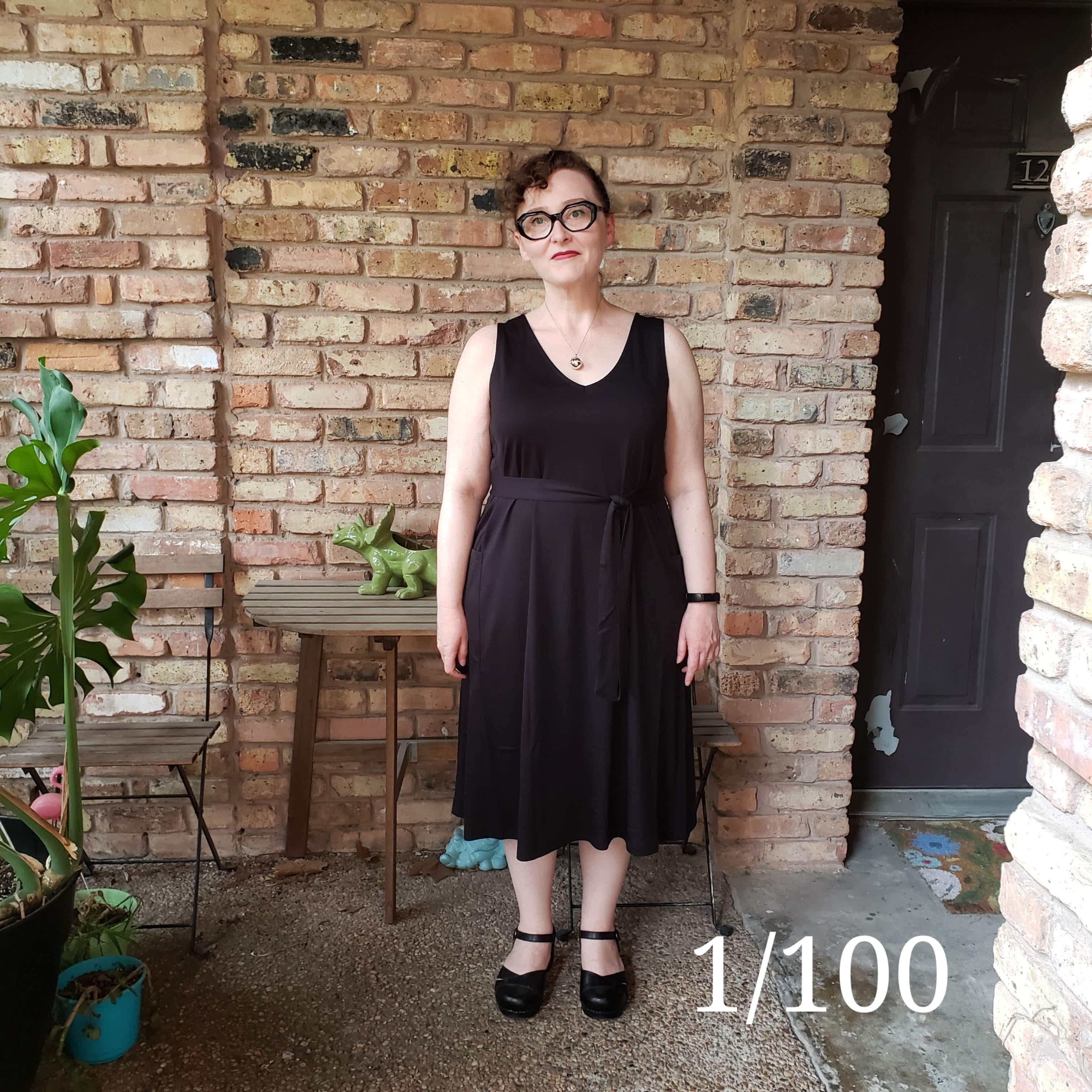
If you wear one of their dresses for 100 days straight, they give you a $100 gift certificate. That seems pretty extreme until you check out the hashtag on Instagram and realize that no one will notice unless you tell them what you're doing. Also, who doesn't love a gift card? I decided to do it, ordered the Summer Midi Dress in black, and took my first photo yesterday. (I didn't want to spam all of my sewing contacts on Instagram with 100 days of a ready-to-wear dress, so I was relieved to see that Wool& will accept a link to a folder of photos on Dropbox or Google Photos.)
If all goes as planned, I'll be wearing the same dress every day until November 5th.
My first impression: I'm really impressed with the dress itself! The Summer Midi Dress is reversible and can be worn with or without its belt. It's a wool and nylon blend and not itchy or hot. It seems very well constructed, and I love that the care tag is hidden in the side pocket, so the neckline truly is reversible. I was surprised that it fit well when worn both ways, as there are no drag lines from my bust -- and the pocket is designed to work both ways, too. It even covers my bra under the arm, which is rare in ready-to-wear. I got a size XL, which corresponded with my measurements according to their size chart, and it was just right. It also worked well for my height, which surprised me. The straps aren't too long, and the pockets aren't too low. This dress is very versatile. Besides the 4 ways it can be worn on its own, I've already figured out 16 different ways to wear it with things I already have in my closet!
This dress isn't for everyone. Some vegans object to using wool, for instance, and the price point ($138) is simply too high for the average consumer. But my main concern is with the dress's size range, as it's not inclusive. This is often the case with sustainable fashion companies – and most clothing companies in general, so this isn't a criticism solely of Wool&. This dress only goes up to a 2X, which is approximately an 18W/20W. The average woman's size in the U.S. is currently an 18W, and it will never make sense to me to stop your size chart where the average begins. (They can't all be Universal Standard, I guess.) I'm also wondering how the fabric will hold up to such intensive wear, although I've read excellent reviews.
If nothing else, this will be an adventure. Wish me luck!
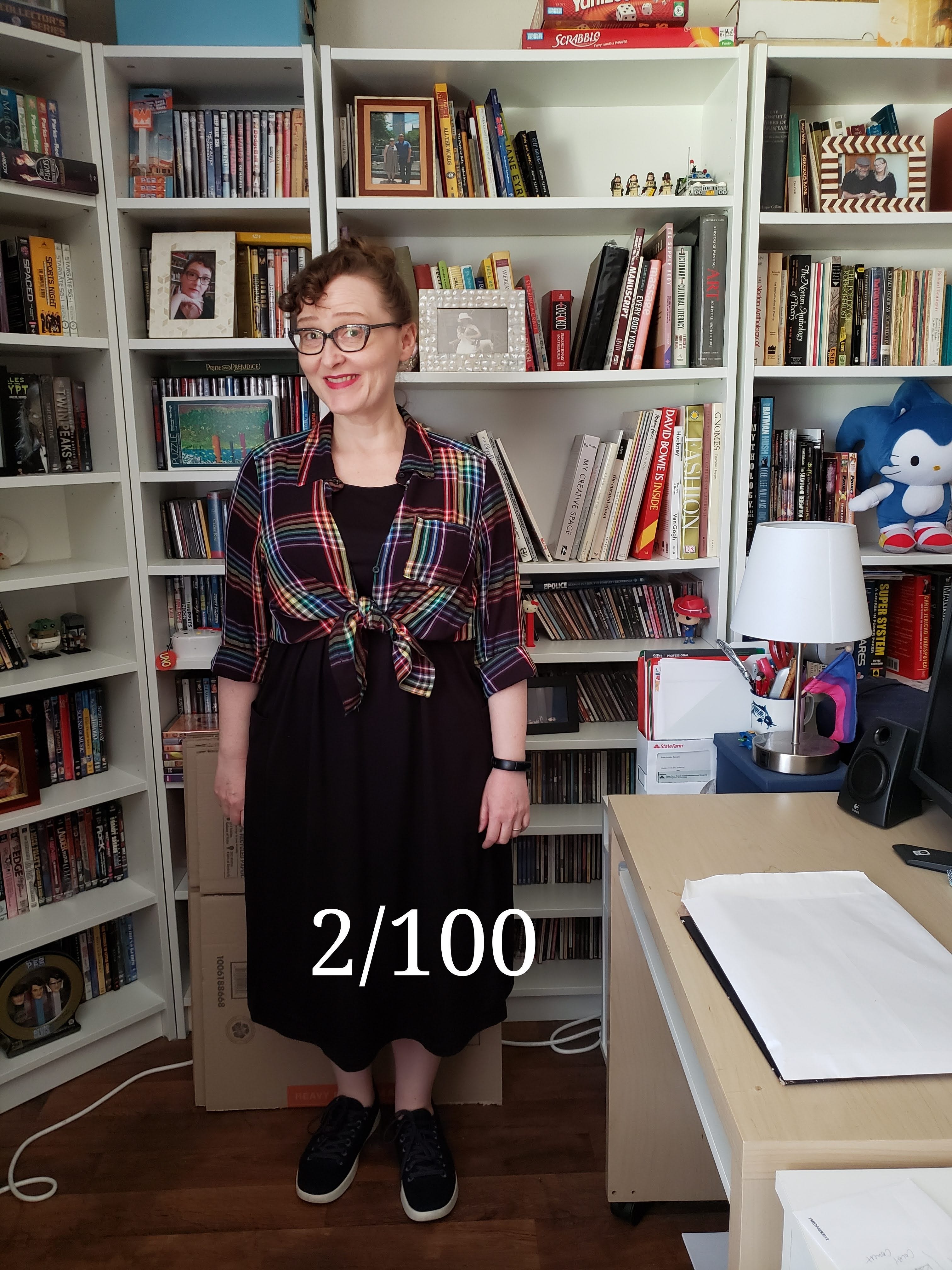
(P.S. My friend Amanda got right to the point with her comment: "I assume you'll be washing it before November!" And the answer is "Yes." However, I chose a wool dress because wool is naturally odor resistant and requires less frequent washing. I'll be airing the dress out every night and washing it whenever it needs it. Just in case any of you were worried!)
(P.P.S. We’ll be revisiting this topic during my 100 days, but this isn’t going to become a sustainable fashion blog. Like, I have way too much weirdness in me to specialize in one topic.)
😆Excellent!
Definitely NOT a dingbat😻
It really is a great dress in practicality, quality and the way it looks on you.
You look fab!✨